
Extending Product Configuration in IFS Cloud with Addovation CPQ
Have you ever wondered how to streamline your configure-to-order process while keeping everything running smoothly in the cloud? If you’re working with IFS Cloud, you’re in luck. In a recent Tuesday morning session, I, together with Andreas Ehrengren, Business Architect at Addovation, walked through exactly how to extend product configuration in IFS Cloud using Addovation CPQ. The session was packed with practical insights, and in this blog, I’ll break down the key takeaways for you.
Written by Viktor Roos, Product Owner Solutions
What Is Configure to Order in IFS Cloud?
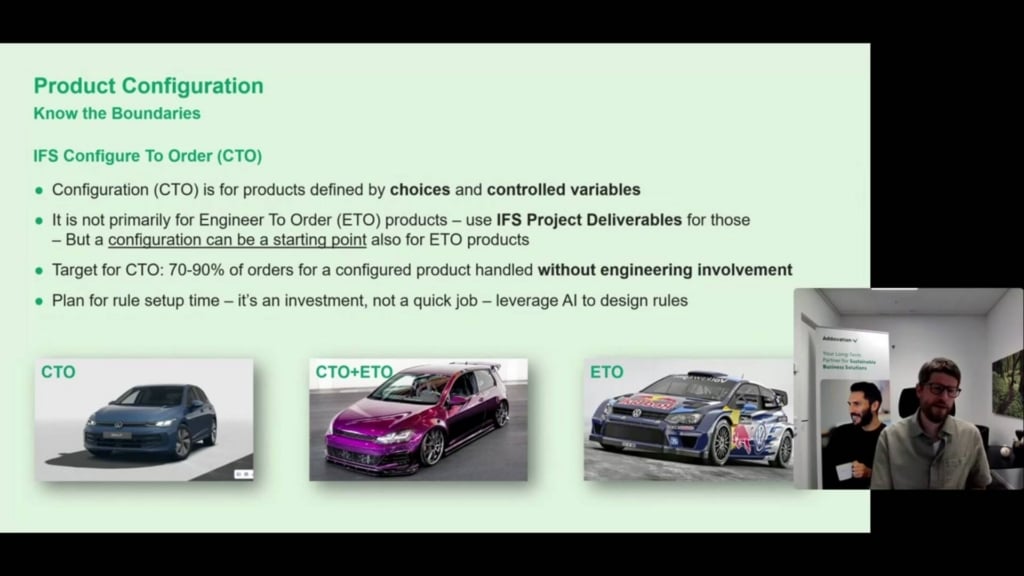
Before we dive into the extension part, let’s talk about the foundation. Andreas Ehrengren started the session by explaining the Configure to Order (CTO) functionality within IFS Cloud. So what exactly is CTO, and when should you use it?
Configure to Order is designed specifically for configured products, those that consist of different variants and components. Think of anything from customized machinery to made-to-order equipment. The beauty of CTO is that it captures complex rules, essentially acting as a guardrail for your sales team.
Here’s the key benefit: any sales representative can define a valid and buildable product when selling through IFS Cloud. This means no more guessing games, no more manual calculations that lead to errors, and no more frustrated engineers trying to make sense of vague order specifications. Configure to Order simplifies the entire sales process while drastically reducing mistakes.
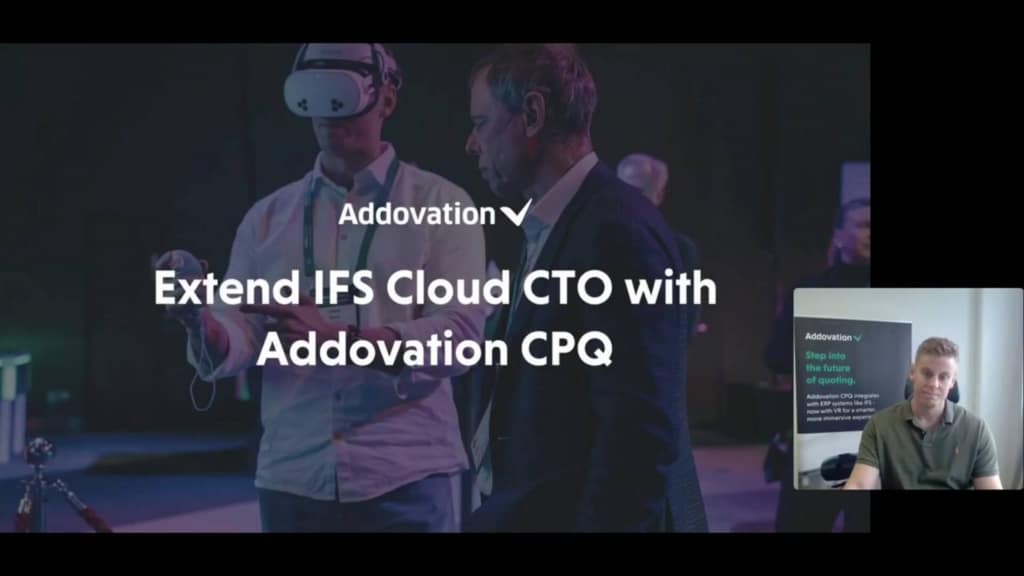
In short, CTO in IFS Cloud ensures that what’s being sold can actually be built. It’s a powerful tool for companies dealing with complex, customizable products.
Extending Functionality with Addovation CPQ
Now, here’s where things get interesting. While IFS Cloud’s native Configure to Order module is robust, many organizations need additional capabilities to fully optimize their CPQ (Configure, Price, Quote) processes. That’s where Addovation CPQ comes in.
I explained how Addovation CPQ extends the native IFS functionality. Rather than replacing what IFS already does well, Addovation CPQ adds layers of flexibility and automation on top. This hybrid approach means you get the best of both worlds: the reliability of IFS Cloud’s core configuration engine plus the enhanced features that modern sales teams need.
Throughout the session, we highlighted how this extension addresses common pain points in manufacturing and distribution things like dynamic pricing, approval workflows, and integrations with other enterprise systems. The goal isn’t just to configure products correctly, but to do so quickly and with full visibility into the process.
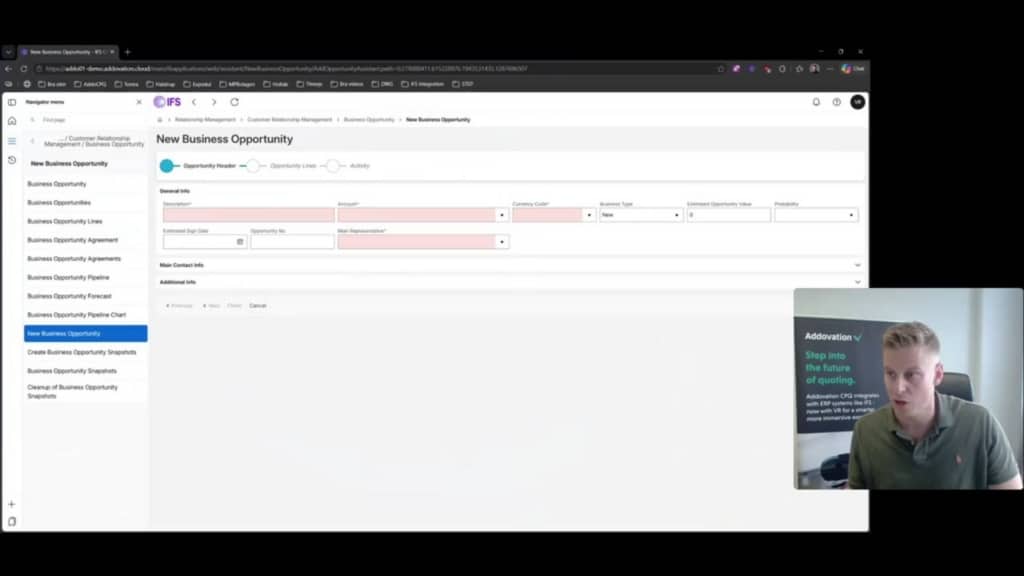
The IFS Cloud Connector: The Secret Sauce
One of the most exciting parts of the presentation was the deep dive into the IFS Cloud Connector that Addovation has built. This connector is the bridge that ties Addovation CPQ seamlessly into IFS Cloud, enabling data to flow back and forth without manual intervention.
Why does this matter? Because in real-world business scenarios, your CPQ system doesn’t operate in a vacuum. Orders need to sync with inventory, pricing needs to reflect current cost structures, and configuration rules need to stay consistent across platforms. The IFS Cloud Connector handles all of that.
Andreas and I walked through how this connector works, emphasizing that it’s been built with robustness and ease of use in mind. It’s not just a technical integration, it’s a business enabler. Companies can now combine the power of IFS’s Configure to Order with Addovation CPQ’s advanced capabilities, creating a unified workflow that accelerates sales cycles and improves accuracy.
A Real-World Use Case
We demonstrated a practical use case showing IFS and Addovation CPQ working together through the cloud connector. They walked through a scenario where a sales representative configures a complex product, how the rules are validated, and how the data seamlessly transfers into IFS Cloud for production planning.
What stood out was how smooth the process was. From initial configuration to order capture, everything happened within a connected ecosystem. No duplicate data entry, no reconciliation headaches, and most importantly, confidence that the order was both sellable and manufacturable.
This demonstration really showcased the value of the integration. It’s one thing to talk about extensibility; it’s another to see it in action and understand how it solves real business problems.
Wrapping Up
So what can you take away from all of this? If your organization uses IFS Cloud and struggles with complex product configurations, extending your capabilities with Addovation CPQ could be a game-changer. The IFS Cloud Connector makes integration straightforward, and the combined solution addresses both the technical and business sides of configure-to-order processes.
The session wrapped up with a Q&A, where attendees had the opportunity to ask specific questions about implementation, pricing, and technical details. If you’re curious about how this might work for your business, that kind of personalized conversation could be incredibly valuable.
Are you currently using IFS Cloud’s Configure to Order module? What challenges have you faced in extending it? We’d love to hear about your experience, or help you explore how Addovation CPQ could fill the gaps. Reach out to get a free workshop or learn more about the IFS Cloud Connector and how it might transform your sales and operations workflow.
Watch the webinar on-demand!
More about Addovation CPQ
 Read more
 CPQ Video Interview With MP Bolagen
With Addovation as their implementation partner, MP Bolagen share their experiences with the Addovation CPQ product.
 Read more
 CPQ Video Interview with Expodul
Watch Expodul Uterum’s VD/CEO, Thomas Thyselius, talk about the experience they had with Addo CPQ and why they chose Addovation and this product.
 Read more
 Press Release: Tomra selects Addovation to Enhance Sales Processes with Addovation CPQ
Tomra selects Addovation to Enhance Sales Processes with addo CPQ.